A short (ten minute) sensitive piece on the movie Brokeback Mountain, with telling interviews with the cast.
Heath Ledger: 1979-2008 Actor Heath Ledger Remembered ABC News - Heath Ledger was found dead Tuesday in a Manhattan apartment, naked in bed with prescription sleeping pills nearby, police said. The Australian-born actor ...
Ledger Autopsy Is Inconclusive New York Times, United States - By Sewell Chan An autopsy of the actor Heath Ledger was performed on Wednesday morning, but the results are inconclusive, according to Ellen Borakove, ...
Heath Ledger with Siena Miller in a still from his film Cassanova.
Heath Ledger: An Appreciation People Magazine - By Leah Rozen Following his untimely death yesterday at age 28, Heath Ledger is likely to be best remembered for his role as a taciturn gay cowboy in 2005's ...
Remembering Heath Ledger Salon - He was young, he was beautiful, and he had a pure gift for playing troubled souls -- which makes the actor's death all the more tragic. ...
A character actor with character in a pushy world The Age, Australia - 8 hours ago HE WAS young, prodigiously talented and, more than that, absolutely straight-up. Heath Ledger was a Hollywood star who didn't play Hollywood games; ...
Heath Ledger as Bob Dylan in a still from the film I'm Not There
Astralian actor Heath Ledger has been found dead in his Manhattan apartment.
Ledger's Death Is Film World's Loss NPR - by Kim Masters Morning Edition, January 23, 2008 · An autopsy is scheduled Wednesday for actor Heath Ledger, a day after the 28-year-old movie star was ...
Family of Heath Ledger deny Brokeback star killed himself Times Online, UK - The family of Heath Ledger, the film star who was found dead last night in his New York apartment, have categorically denied that the 28-year-old Australian ...
Hollywood mourns sudden death of "Brokeback Mountain" star Xinhua, China - LOS ANGELES, Jan. 23 (Xinhua) -- Leading figures in Hollywood Wednesday continued to mourn the sudden death of Heath Ledger, a rising star who was hailed as ...
Tributes pour in for Brokeback star The Press Association - Heath Ledger will be remembered for delivering "some of the greatest performances by an Australian actor", the country's prime minister said. ...
Australian actor Heath Ledger, left, and US actor Jake Gyllenhaal
New York Police Department statement following the death of Heath Ledger at his Manhattan apartment.
January 22, 2008
A timeline of the career of Heath Ledger:
— April 4, 1979: Heath Andrew Ledger born in Perth, Western Australia.
— 1995: Joins the Globe Shakespeare Company in Sydney and acts in independent films.
— 1996: Plays a cyclist hoping to land a spot on an Olympic team in the TV show "Sweat."
— July 1997: Stars as a Celtic warrior prince in the TV series "Roar."
— 1998: Moves to the U.S. Still hasn't taken any acting lessons.
— Spring 1998: Cast opposite Julia Stiles in "10 Things I Hate About You," an updated "The Taming of the Shrew" in a high-school setting. Then chooses not to work for over a year because he doesn't want to do another movie about teens.
— Spring 1999: Cast in the Revolutionary War drama "The Patriot," playing the son of Mel Gibson's character.
— Spring 2001: Stars in "A Knight's Tale."
— Winter 2001: Plays the son of Billy Bob Thornton's character in "Monster's Ball."
— March 2004: Stars as the title character in "Ned Kelly," playing the Australian outlaw. Is dating actress Naomi Watts.
— April 2004: Works on "The Lords of Dogtown," a fictionalized version of a cult classic 2001 skateboarding documentary, which is filmed in the Los Angeles area.
— June 2005: Moves to the New York City borough of Brooklyn. His girlfriend, Michelle Williams, is expecting the couple's first child. They met while filming "Brokeback Mountain"; she plays his wife in the movie.
— August 2005: Stars opposite Matt Damon in Terry Gilliam's "The Brothers Grimm."
— Oct. 28, 2005: Matilda Rose, his daughter with Williams, is born. Regarding a possible wedding, he tells Canada's National Post in 2005: "Look, I wouldn't rule it out. But if I was going to marry, the media won't know about it."
— Dec. 16, 2005: Ang Lee's "Brokeback Mountain" is released.
— Jan. 31, 2006: Nominated for a best-actor Oscar for "Brokeback Mountain."
— Nov. 11, 2006: Stars as a heroin addict and sometime poet named Dan in the film "Candy."
— September 2007: Breaks up with Williams.
— Nov. 21, 2007: "I'm Not There" opens. Ledger is one of the actors playing Bob Dylan, along with Cate Blanchett. Williams also stars.
— 2007: Plays the Joker in Christopher Nolan's "The Dark Knight," a sequel to "Batman Begins." Film is due out in 2008.
— Jan. 22, 2008: Ledger's body is found in his Manhattan apartment. He was 28.
Is-it-or-isn't-it-a-documentary :: Street Thief Review by Paul Grant (follower of Basho) Trailer at the Bottom
The single fact that the director Malik Bader plays the main star Kapser Carr informs you that this is a fake documentary. But in style and `grit', it feels real. The mock-doc was filmed in Chicago, where the filmmaker and star lives (wicker Park). "When we made the film, our goal was to kind of give people a real look into the life of a burglar," Bader told Mike Thomas of the Chicago Sun Times.
Bader tells Thomas: "So we didn't say, 'How can we make a cool film that fools people into thinking its real?' We just said, 'Man, how can we make this s--- real as hell?' "
masterful camerawork are a highlight of the film. using shaky undercover-style footage and unusual techniques like the grocery cart cam and the helmet-cam give the film just the right `this is a documentary' look. The cutting and the subtle music give the film the crucial suspenseful edge that makes it fun to watch. The story is intercut with separate interviews of another professional thief in prison, discussion with an attorney, and with police officers all of which come off natural. And interviews with the main character give depth to the story.
The movie is short at 90 minutes.
To give the reader more information we culled together more information about the film Street Thief.
Other notes:
Direct Hit:: What inspires Wicker Park filmmaker Malik Bader's neo-noir movies? Chicago's gritty underbelly. By Veronica Hinke Chicago Magizine
This article appears in the June 2007 issue of Chicago Magazine.
Wicker Park filmmaker Malik Bader
When Michael Moore, the king of attention-grabbing documentary movies, asks you to fly to his film festival in Traverse City, Michigan, and speak about an emerging genre called "dangerous" documentaries, you know you're raising some eyebrows. That's what recently happened to Malik Bader, the director of Street Thief, which stunned audiences at the Tribeca Film Festival. For the project, the filmmaker sought the advice of professional burglars before attempting break-ins on camera.
"To stand out on a limited budget, you've got to make things happen," says Bader, 33. "We wanted to make something that would get people's attention."
It did. Street Thief, which gets its cable première on June 21st on A&E, played at festivals as far away as Buenos Aires and Locarno, Italy. At every stop, people approached Bader, curious whether the slovenly main character, Kaspar Carr-who trolls corner marts, movie theaters, and clubs in search of the perfect heist-is a real thief. Like Borat mastermind Sacha Baron Cohen, Bader becomes elusive when asked what in the movie is fiction and what, if anything, actually happened. "All of our filming was done covertly-cameras in helmets, little cameras in bags," he answers cryptically. "We put our money where our mouth was-making it as realistic as possible by interviewing real burglars and not using extras."
Bader's inspiration stems from such films as Stanley Kubrick's Full Metal Jacket and Martin Scorsese's Mean Streets and from movies he and his younger brother, Sam, used to sneak into theatres at Ford City to see. They'd nestle into the back row, squirreling away ambitious filmmaking fantasies of their own. In 2000, the pair founded Bader Brothers Productions in Wicker Park, where Malik lives with his wife, Norma. The brothers are currently at work on a fraternally themed script about a criminal who returns home to Chicago to help his sibling accomplish one last score. Although he had a leading role in the film Death of a President and has recently signed with Creative Artists Agency, Bader plans for now on staying in the Midwest. "There are great places to film in Chicago," he says. "We've shown it's realistic for filmmakers to achieve goals right here."
So does the crime occur because of the crew’s presence? Or are they just tracking events that would happen anyway? With Street Thief, Bader questions the concept of reality… so on the eve of his TV premiere, we questioned him:
The Lobby: How did you decide on this subject matter?
Malik Bader: I wanted to capture a truly honest sense of what a successful criminal’s life is like. I realized after talking to a few burglars–some very accomplished–that it wasn’t the crimes that fascinated me. It was the characters behind them. In Kaspar Carr (the film’s subject), I found the prime example. He was sitting and observing society from the outside, never actually taking part. How do you live in a big city and not have any meaningful relationships, all for the sake of your profession?
The Lobby: You guys shot the film on the streets of Chicago — were there any times you felt you or the crew were in danger?
Bader: There were times when we actually were in danger. While filming in the South Water Market, two men attempted to steal our equipment truck — when they were approached, one of them took out a gun as they ran off. And the opening scene was shot in Chicago’s little village, a pretty crazy area where drive-by shootings are commonplace. At one point, a block from where we were filming on 26th, two cars loaded with rival gang members started flashing gang signs at each other. Then, suddenly, gunshots started ringing out.
The Lobby: The film successfully blurs the line between real life and reel life. Are there verite films or filmmakers you’d name as an influence?
Bader: For documentaries, The Maysles Brothers’ The Salesman, Martin Bell’s Streetwise and Man Bites Dog. Other film influences include early Scorsese, Michael Mann, Stanley Kubrick, Friedkin’s The French Connection, Jules Dassin’s Rififi and many others.
The Lobby: I would think the movie is unique enough — and certainly voyeuristic enough — to get theatrical distribution. After a string of film festival success, how did you end up with A&E?
Bader: I would have loved a theatrical run, but more and more, you see independent films getting lost in the shuffle. A&E Indiefilms approached us just after Tribeca. They have a great philosophy and they really champion the films that they acquire. Ultimately we knew with A&E we could reach that large audience.
The Lobby: How difficult is it to discuss the film without revealing more than you’d like?
Bader: It’s not difficult. I want people to experience the film fresh so they can judge what they are viewing on their own as it happens. It makes for much better discussion afterwards, as we learned at film festival Q&As.
The Lobby: Did you feel that spending so much time with a real thief would have an effect on you and the crew? Did it change the way you look at crime?
Bader: Yes it has affected me quite profoundly. If I need money to fund my next film, I could always turn to cracking a few safes…
SB: Were there any changes made between the version of Street Thief that was shown at the festivals and what will premiere this Thursday on A&E?
Malik Bader: Just a little shorter sequence, where he’s kinda scoping out the grocery store, which… that has actually gone through quite a few revisions, because originally when we made the film, you know Kaspar Carr leaves the supermarket, and he goes and changes into this Mexican cowboy dude’s outfit — it’s going to be on the DVD on the deleted scenes. When you break into a place and you turn off their alarm, you gotta leave to make sure the cops aren’t coming. Even if you took out the alarm, even if you really know what you’re doing and you cut the phone wires, there’s always that small chance that somebody saw you or there’s a radio backup and so you leave and come back, and that part we kind of felt that, you know unless you’re a hard-core crime enthusiast, or you’re trying to use this as a how-to video….
It’s kind of, it has kind of a slow pacing, and I enjoyed wondering when the film opens up, what the hell am I watching? Is this guy a burglar, is he a cop? What’s going to happen, kind of not knowing until you see him at the table with all the money going into the counter.
CSB: I hadn’t noticed the change when I watched it….
Malik Bader: Very, very subtle. I mean less than 30 seconds came out of the opening at Tribeca, and four minutes came out from our original director’s cut. Street Thief Casper Counting Money Tribeca Film Festival 2006
CSB: Let’s step back a second then, it sounds like — maybe not an inspiration but just your sense of approaching the film — your goal was to put the audience in the shoes of the person who is committing a burglary, understanding it, being there, in contrast to an Ocean’s 11-type, surreal portrayal. When did you first become interested in that, or when did you first think about trying to get to it from that angle?
Malik Bader: I’ve kind of been familiar with the whole world of crime, just growing up in Chicago. You’re always kind of fascinated by crime, and then you start to make friends that are in those circles, and some grow up and leave that stuff behind, and some take it to the next level. I knew these guys growing up and I knew some of these guys that made their living as professionals in certain fields, but they were also burglars, and I knew guys who were strictly burglars. I mean they had their car and their apartment and their lives, and these guys you knew took down scores. I mean, they didn’t go around advertising it, but you knew. And some of these people, I would hear their stories and find them unbelievably fascinating, just ordinary people that you think are graphic designers or bankers — and they’re not taking down the place they work at, but they’re taking down like night club scores and grocery stores and gas stations. And the guys who usually get away with it are guys that you know selectively look for their places, that aren’t dying to get $500 bucks, that don’t have drug habits. Guys who, you know, have kind of a controlled life, and it was trying to examine that. And also the anxiety that even a guy like Kaspar Carr goes through before a score and the paranoia. How the hell do you cut yourself off from relationships and not trust anybody — to not want anything long term with this kind of goal in mind?
And also his outcome, you know, I wanted people to question — is he just smarter than all of us and he just had this sh*t planned out from the beginning? Or, was this a guy who when, finally, he found these filmmakers and this attention, it set into this thing that fit into his life. Wanting to be the center of attention and talk and teach. So it was kind of a mix of all those things. But mainly it came from my experiences and my knowledge of crime and never really seeing that true essence in any Hollywood films, or even a lot of indie films. I mean, there are great films, but when it comes down to the character and what he’s going through — I mean a guy just pulled down a $7 million dollar heist, and they’re just happy and excited, but you didn’t see him going to the bathroom 17 times. And we talk about that in the film and just try to bring a life to that… how these guys go about and live their lives.
CSB: Excellent, I think the grittier the better. For me, an open question when we were watching the film was, when this guy says he’s two steps ahead of you, is he really two steps ahead of you or is he just trying to justify to himself….
Malik Bader: Exactly, exactly and I think you can see it that way. Because as a filmmaker when you step back and say “let’s make this real”. And we really put our money where our mouth was in every single respect, the film can‘t be — and I don‘t think I’ll ever be able to do that in any of my films again, where you can’t poke one hole in the film, like just plot-wise, story-wise. I’m writing a script right now and it’s hard, I just come from that school where it’s like “f*ck, it’s got to be real”. And any film I watch, it’s never real. Like I watch Michael Mann, I watch this, I watch that and Michael Mann is a guy who’s trying to keep it crazy-real. And I watch Miami Vice and I’m like “that can’t happen, that won’t happen, that ain‘t gonna happen..” But, to make a film, you gotta bullshit, and we didn’t want to do that in Street Thief.
And I’ve totally lost track of what the hell the question was…..
CSB: It’s all good, I was really just rambling. It seems like, one of the real challenges for this guy, Kaspar, that he has this secretive world that he builds up and the big exception is that he’s here on camera, and he’s got this need to talk. Was that something you tried to reconcile as far as the character, or was that just a needed fiction to get the camera focused on this character to make the movie?
Malik Bader: Yeah, it’s kind of like — I love crime. And I want to make a movie about burglars. And I want it to be real, and how do I do that? How do I make that happen? Initially we started to come up with these like, not bullsh*t, but these scenarios for how the filmmakers met Kaspar. And we had it all worked out, they were interviewing burglars in prison, and we were also going to do these sitting head interviews with real burglars, that I knew from Chicago, where they talk about why they went to jail and what they did — and it started to take away from the story. So the reason the one guy is still there, is to kind of break up the story, to get away from Kaspar for a minute or two, give it something to relate to, like “Oh, this is how that started. This is what climaxed in leading them to Kaspar.” And we were going to get into them meeting him, and how they found him, and kind of more discussions of like “can we finally go along with you on a score?”, and a little more info. It was more fun to hear this crazy, chain-smoking, you know, eating like a fat slob, foul-mouthed, real character, that it was getting into all of that. So we just left it up in the air and said if you really start questioning why this guy would do it, you’re never really going to truly find an answer, because he is not going to let us know, he’s not going to tell us. I know why, but I’ll never give that away because it should never be given away.
It was just a lot of scenarios from the people I met and the stories I’ve heard, and my own assumptions and ideas. If a guy wants people to think he’s dead, there are ways to do it, that are inconclusive but it’s inconclusive to the point that people who just want to close their cases will just kind of close them. [At this point in the interview, the phone connection cut out somehow. The interview resumed a minute or so later.]
CSB: So, it sounds like the answer to the question why would a guy like this open up on film is essentially that, you’re not going to get a satisfactory answer to that, so it makes more sense just to leave it?
Malik Bader: I think it’s more fun that way. It’s part of what I truly like… the most exciting thing for me was leaving the theater, and watching other people leave the theater talking about the film. “Dude, it was f*cking real” and “Dude, they were really doing those scores” and every one of our screenings in the US — and I’ve gone to all of our screenings — were sold out. And people, old ladies at the Tribeca thing were like clapping after the last score….. [at this point the phone cut out again. We got back on a minute later, this time for good…]
So, yeah, I think that’s kind of the fun of it, letting people come to it on their own, why would this guy do it, I think you can tell that he’s lonely, and he doesn’t have a lot of friends, and he’s got these guys that he can truly control, who have something from him that they really want, and they’re willing to go by his rules — that is rare to find. And there are rules that he has with them that we don’t really know, like who’s holding the film, who’s holding onto the tapes, and what are the rules for when they can come out to tape. And we had rules in our minds as filmmakers. We don’t really know them as viewers, but they do exist. In this situation, there would be, you can do this or you can’t do that. That’s why we show him hunting later, we wanted to take it out, and you know, if that really happened, time would pass, and you would just have to sit there in your office waiting for this guy to re-appear.
CSB: It sounds like the film evolved, so that at first it was going to focus on a lot of characters, and it evolved to focus mostly on Kaspar, so that the character who is in jail is now a fairly minor character. Did you consider taking him out altogether?
Malik Bader: Definitely, we did. Like when we started editing it together — the film was really made in editing which is closer to the way a documentary film is made, because we did shoot a lot of extra stuff in addition to what we wanted to shoot. And we wanted it to feel very spontaneous and just come together the way a doc would come together. And so, in the end, it’s very close to what our initial idea was, but it was just kind of cut up and shaped differently. And we did consider, did we really need him, and we felt we wanted to get a little break from Kaspar. And since it isn’t a very plot-driven film, in the beginning you’re just learning about this guy’s life and you’re just wondering what’s going to happen, you know, what’s going on? And we wanted something to just, you know, we could leave Kaspar for a minute and hear this guy’s story and get back to the action to find out what’s going on. So that it’s not all just talking heads, but it’s also not just Kaspar just plying his trade and taking down scores.
CSB: We watch a lot of foreign films here at CinemaStrikesBack.com and when it comes to crime films, today’s Hong Kong movies in particular, there are reports that some productions are tied in with actual gangsters, the “triads”, and the filmmakers have these guys on the set advising them, to keep it realistic, the “triad” culture, I guess.
Malik Bader: I love these films, some of these films I watched, like Triad Election was one of my favorite festival films from last year. I watched it at Chicago International last year, and it sucks that it never came out here in theaters or on DVD, I really just can’t understand that. I ordered it on Yahoo, from like overseas and just never got it. And after Tribeca, you have all these scripts and agents coming at you from Hollywood, and all this stuff, and when you watch a film like that, you’re like “Oh, now I remember why I want to make films”. So, it’s kind of, you know because it is cinematic, and you can feel the filmmakers kind of hand in it, and the way its put together, I just really enjoyed those movies.
CSB: Similarly, in different periods in the past, some of the old 70s yakuza movies from Japan for example, had actual gangsters on set advising the filmmakers (or making the films themselves in the case of Noburo Ando), so I began to think about this as I was watching your film again last night. I read somewhere on the Internet where you were talking about how there was someone on the set of Street Thief the whole time, an actual burglar advising you on….
Malik Bader: That was one thing in [the article at Traverse City Record Eagle (click here for link)], I think it was just taken out of context. We didn’t have, there wasn’t a burglar at all on set telling us what to say or kind of like advising us. But what I did say was every crime in the film was based on an actual crime that went down. Whether I knew the person who took it down, or heard from somebody who knew the person who took it down. Mostly, it was me knowing the person who took it down, reading about them, I had friends who gave me like the police reports and friends who gave me transcripts, and I interviewed some cops, and I’m very close with one guy who was on the run for two years, he went to Mexico, he came back, and they caught him in like a sting operation, and he went to court and actually beat the case. And some of the things the guy in jail was saying were based on his real life. And every aspect of the film like I said I wanted it to be able to hold up. So, we didn’t put anything in there that we thought could have happened, or that we thought it might happen this way, it’s all based on real stuff and how to take down a score.
And also, we tried not to involve too many people, like at the supermarket with the helmet cam, there was no crew that walked in with me, that was my helmet cam, I made it, I walked into that supermarket, the only person who knew was the owner, who wasn’t at that location that day. I just walked behind the counter, behind the butcher’s line, I mean, it was all like the way it really went down. In addition to that, the attorney, the lawyer, we went there and he thought we were like real filmmakers, he’s a partner of my attorney, and he had no idea. He’s trying to talk to my brother who’s a producer, and he got so angry that we wanted to call the cops. He was like “you guys are dumb, you don’t call the cops, I‘ll make sure you keep your f*cking footage, just don’t call them, there’s no need to call them. Let‘s get this sh*t done the right way”. And we’re like “no, you gotta call them.”
And I’m sitting with the guy, the cop, waiting for the call, the lawyer thought they were so stupid, he typed up a quick disclaimer, saying you guys are like retards, and I’m not going to be held responsible for you guys later, when they take all your footage. So, he was advising guys on a real case as to what the circumstances of the film we made were. The movie theater — I really cut open a display, and crawled into it. And I filmed patrons. And, of course, I would get releases from them, you know, after they knew they were recorded. The behind the scenes production people would run up to people and say “hey, can you sign this, we’re making a film” but nobody knew we were recording them. So, you know, I could really disarm alarms, I could really record people’s phone conversations, I could really cut open a safe during the filming of a film. And those things were all real, in fact. So, those are things you don’t see in a big budget film, or you can’t really do it, you can’t take those risks.
CSB: That was going to be one of my questions, did you get releases, did the supermarket know? And it sounds like maybe after-the-fact the answer is yes, but before-the-fact, no.
Malik Bader: It was like, wherever we could get away with it, after-the-fact we did. So, for example, we got permission from the police department to film at that police station, the film office. But the cops there, they didn’t know. We wanted them to come out and chase us away, but they didn’t, you know. So we tried to push the envelope as much as we could. In the South Water Market, where Kaspar is telling you that they’re tearing the place down to build condos, well to get the shot we wanted on the back fire escape, we had to break into the wrong place. But, we were hoping to God after we pried the door open, because they were like going to demolish the place in the month, so we didn’t think there would be any damage anyway. But that’s like, you gotta get the shot, it’s really important. And I thought, we pretty much are real burglars now, so let’s just get this open and get the shot, it was to an abandoned wearhouse already, so we didn’t really break in anywhere. But it gets to the point where you’ll do it under any circumstances to kind of deliver what you’re trying to deliver here.
CSB: And I would think, especially for an airing on A&E, I would think it’s hard to get Tribeca comfortable, but it’s got to be especially hard to get A&E comfortable for a national broadcast…
Malik Bader: A&E just wanted to make sure, like they were just worried because my brother who was involved in that criminal case, that has nothing at all to do with this film, it’s just something that coincidentally happened on his own. Which, kind of, you know, people, journalists love to take things and run with them, and I guess that’s just the nature of the beast. But to make a long story short, they just wanted to make sure, you know, you need releases for every single thing, and you need to get errors and omissions insurance, and they just wanted to make sure that the project was legit. And, I felt that A&E was a weird kind of like, match for the film, because what they show is just not that crazy and provocative, and you know, it’s not HBO, and you know this foul-mouthed crazy burglar, but the executive Molly Thompson over there just loved the film. And when we started to think do we go with a smaller company to put it in a limited theatrical release in four to six theaters, and then cross our fingers and then nothing happens? And you have this opportunity to have A&E’s entire viewing audience watch the film? And it kind of becomes more about having as many people as possible enjoy the film and watch it.
CSB: You know, ever since seeing your film at Tribeca, I would periodically do an Internet search for news about it, and it seemed like the official website that was up for it disappeared, and…
Malik Bader: Yeah, we did that, not purposely, but kind of purposely, because it was still in the air, and what was going to happen with it. We thought we’d do more harm than good, if someone came out and wanted to get rid of everything out there surrounding the film, and bring it out as if it was something real, and if a distributor wanted to do that, I wouldn’t have anything against it. So, I kind of wanted to leave that option open for whoever picked it up and distributed it.
CSB: A couple months ago, I finally found something listed on a subdivision of A&E’s website, like they were just starting to seek out advertising for it before an announcement had been made that they would be airing Street Thief, and we actually put a post up on the website about it…
Malik Bader: I actually noticed that, I saw that and I was like “holy cow, these guys are good”.
CSB: But I was like, wow, A&E, I wouldn’t have… you know, like, ok, good for A&E, but, hey, I think that‘s cool….
In any case, what I was trying to get at before (when I was comparing Street Thief with these triad and other crime movies), is that they basically described themselves as simply realistic crime dramas. Did you ever consider pitching it or describing it to people that way? What led you to want to emphasize a half-documentary, half-real aspect to it?
Malik Bader: It really came, for me it was more about feeling. You kind of get caught up in what you’re preaching or what you’re talking about. And we thought, if we tried to pull off a realistic drama, it’s actually much more difficult to do that than what we accomplished in Street Thief. You’re making a film, but you’re also trying to make it as realistic as possible, so how do you match up? We wanted to get attention for ourselves, we wanted people to take notice — I wanted people to take notice of what I was capable of cinematically, but also make something that people enjoyed. How do you match up to something like Heat, or Thief, or any Scorsese film on a tight budget, running and gunning in Chicago? So, we knew we couldn’t do that. My thing was how do I deliver a real look into the life of a burglar. And initially, it was really more about things like feeling. Like, I wanted people to really understand the tightening in a person’s stomach, and all the anxiety and hard work that goes into it. And of course some of that gets lost because you know, you’re trying to make a dramatic film, even though it is in the style of a kind of cinema verite or documentary of whatever you want to call it, you still want it to be dramatic and some sort of a ride for people. So, it was something that was thrown around, and it came from I wanted to give people a true look into the life of a burglar, and experience kind of what he experiences and feel what he feels, and it kind of came more from that than anywhere else.
And we knew it was going to be hard. We thought about maybe opening it up, and we talked about the ending. We had this idea where he would disappear, you would see the blood, and instead of the documentary searching for him, it would cut to like a beautiful 35mm, really anamorphic, kind of widescreen look, with these same documentary filmmakers in their office, with all these academy awards and all this shi*t on their shelves, and these guys are like “holy sh*t, you’re not going to believe it” and they run into a conference room and on the TV set, it’s like a Brazilian film crew, and Kaspar Carr has been spotted. And after this, what we were going to do was make the first two-thirds and after it was over, give this feeling that there was this cult following after Kaspar Carr, and after the documentary that had been made years prior, and you had just watched that documentary that was made years earlier, and here it is now, and on this Brazilian news, Kaspar Carr has been spotted, and all these Brazilian news teams are in front of his house, and Kaspar Carr comes out, and he’s married this Brazilian chick and they had a baby, and they can’t extradite you for non-violent crimes from Brazil, if you have a kid in Brazil, to the US.
CSB: Wow!
Malik Bader: There were other ideas, but where we were putting it together it was like so real, and so, and it was more real than we anticipated it would be. The sales agent who picked it up thought it was real, the publicist thought it was real. The Hamptons Film Festival and AFI Film Fest both invited it to be in competition as a real documentary, and we had to convince Tribeca not to list it as a documentary, and that’s another thing out there, that we tried to convince people, that we tried to pull the wool over people’s eyes. But we actually went out, that’s why I did the Q&A. You know, I didn’t want this film to be about is this real or not, I wanted it to be about, is it good or does it suck? And, so, but I think I f*cked up, I think I should have just not showed up, and there would have been a much crazier buzz about the film. And me worrying too much about the wrath of journalists had us go down the … And after we went down a million little pieces, this thing broke on Oprah, and so the publicist really worried about lying to journalists and putting a disclaimer out, and “what you were about to view is not real”, and we were like “man, the timing sucks for us so bad”.
CSB: It’s funny, I guess, I hadn’t scrutinized the credits enough, so when you walked out at the end of the screening as the director, it was like “Oh! Well…”
Malik Bader: Isn’t that fun! That was fun. And not that I fooled people. But it’s got to be exciting to see something and think it’s real, and then realize that it’s not. And I wanted that secret to be kept, and I just wanted viewers to watch it on A&E and argue about it. Like, I argued with my brother about Man Bites Dog. I don’t know if you’ve watched that film?
CSB: Sure.
Malik Bader: There’s that lady on the couch, and I don’t know if he shoots her, or what — he gives her a heart attack. And my brother was like “Bro, that’s f*cking real” and I’m like “Come on, it’s a film” and we know it’s not real, but we’re arguing about it. You know, it’s part of film, and it’s part of the fun of it. And that all happened after the fact, but it’s fun to kind of watch and experience.
CSB: I remember, at the screening I was at, literally the first question was “Why aren’t you in jail?” and then someone asked for their money back… and part of me was thinking “Wow, I thought we were all just having fun here”, but then I’m also wondering did you plant all these people to drive up the buzz?
Malik Bader: No, no. And you know, the only questions that pissed me off were the questions like “the documentary genre is so sacred, and what you’re doing is so wrong”. What does that have to do with this film, dude? You’re mad because you bought it, and you should be happy, because now you’ve truly experienced something that… Believe me, people are smart enough to know, that if they’re watching a doc and it’s not real, they’re going to know and they’re not going to buy it. You know, and if you’re watching it and it’s totally blown out of proportion, and it’s billions of dollars he’s taking, and kind of doing these high-tech explosions like De Niro does in The Score, you know, I think that’s part of why people were upset, because they bought it, and they just wanted it to be real. And I think most of those people are more the filmmakers than the average viewer.
So, yeah, that was — were you at the first screening when there was this old guy asking “Where did you find this guy and why did he agree to do it? And why do you look so much like him?” And I thought he was joking and was like “ha ha, next question” and he was like “No really, where did you find him and why do you look so much like him?” And a guy in the back yells “Yo, clean up your motherf*cking glasses”.
I'm Not There movie review by Paul Grant Follower of Basho Movie trailer at bottom of post
This movie is a wild trip of convoluted stories skillfully intertwined to give the viewer a series of perspectives on the life of musician, Bob Dylan, with multiple actors embodying different stages in the singer's life.
I have been told the more you know about Dylan, the more you will like this film. Roger Ebert writes: If you are not much familiar with Dylan, this film is likely to confuse or baffle."
A. O. Scott writes in the New York Times that "Devotees of Dylan lore will find their heads swimming with footnotes, as they track Mr. Haynes’s allusions not only to Mr. Dylan’s own music but also to the extensive secondary literature it has inspired, from books by David Hajdu and Greil Marcus to films, including D. A. Pennebaker’s 1967 documentary, “Don’t Look Back,” some of which Mr. Haynes remakes shot for shot."
And on top of being a Dylan buff, being a movie buff can make I'm not There' more enjoyable. (Haynes shoots the Blanchett sequences in a gritty black and white (aping the look of D.A. Pennebaker's 1967 Dylan film "Don't Look Back," with a few nods to Fellini) and the Bale section as a sub-Scorsese rock doc, but the Billy scenes are done up as a 1970s revisionist western - Altman's "McCabe & Mrs. Miller" by way of "Pat Garrett and Billy the Kid," in which the singer appeared. Some commentators have found the Gere bits the weakest link in "I'm Not There," but if you know the films and you love "The Basement Tapes," they can seem terribly emotional: a ramshackle mini-movie in which Dylan the weary recluse presides over the death of the hippie dream.)(Ty Burr)
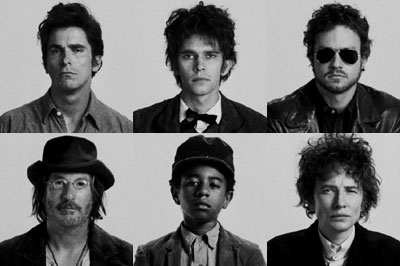
One of the actors is a young African-American boy (Marcus Carl Franklin) who claims to be Woody Guthrie; a second is Jack, a Greenwich Village folk singer (Christian Bale); a third is Robbie (Heath Ledger), appearing in a Hollywood film, who settles down, gets married and has kids; a fourth is Jude (Cate Blanchett), a hero who alienated his fans by switching from acoustic to electric guitar and from folk to folk rock; a fifth is an actor (Richard Gere) appearing in a Western about Billy the Kid; a sixth is a Dylan (Ben Whishaw) submitting to a contentious interview about his career, and then we double back again to Christian Bale, who plays either a seventh or a transformation of the first, Pastor Jack, a born-again Christian.
At one point the character comments that it takes a thief to catch a thief, and in some sense that reflects the idea that it takes an artist to catch an artist- in this case the artist /Director and co-writer Haynes trying to catch Dylan - without in any way possessing him. It seems clear that in Haynes 's opinion that if he were to make a straight bioptic about Dylan - it would be an attempt to own him and his story.
Cate Blanchett as Jude Quinn (a version of Bob Dylan) and David Cross as Allen Ginsberg in Todd Haynes' "I'm Not There."
Using chaos and mystery and riddles Haynes gives us a series of Dylan's that Dylan would probably deny - one and all- with the simple- `thats not me- you don't know me." (“I couldn’t believe after all these years/You didn’t know me better than that” as Dylan sand in in “Idiot Wind”)
Beware, some have called it discordant, disjointed disappointment (Claudia Puig, USA TODAY)who also said it's not nearly as enjoyable as one of his rambling, meditative songs. While others believe it is :" a work of staggering cinematic craft that's part jigsaw puzzle and part meditation on the mysteries of art and stardom." ( Ty Burr, Boston Globe.)Mr. Burr also wrote : "Fair question: "Will any of this matter if the singer means little or nothing to you? Possibly not, although if you want to see our culture of celebrity engaged at its most primal level, or if you just enjoy supremely confident moviemaking, the film can't be dismissed."
Haynes is a formalist who likes to experiment, be it queer-world fantasy (Poison), glam rock (Velvet Goldmine), environmental terrorism (Safe {One of my personal all time favorite films}) or 1950s melodrama (Far From Heaven). Dylan thought enough of Haynes to give him rights to his music.
Cast & Credits John/Jack: Christian Bale Jude: Cate Blanchett Woody: Marcus Carl Franklin Billy: Richard Gere Robbie: Heath Ledger Arthur: Ben Whishaw Claire: Charlotte Gainsbourg Alice: Julianne Moore
The Weinstein Co. presents a film directed by Todd Haynes. Written by Haynes and Oren Moverman. Running time: 135 minutes. Rated R (for language, some sexuality and nudity).
Many people have covered Bob Dylan's songs over the years, but few quite like this. On the double-disc soundtrack that accompanies Todd Haynes' extremely confounding biopic of the already plenty confounding folk icon, we get the likes of Sonic Youth, Cat Power, Yo La Tengo, the Hold Steady, and Antony & The Johnsons doing their best Dylan impressions and often failing gloriously. Former Pavement frontman Stephen Malkmus does a particularly fine job oozing his way through "Ballad of a Thin Man," while Wilco's Jeff Tweedy draws the moody beauty out of "Simple Twist of Fate," and Sufjan Stevens lends his typically baroque touch to "Ring Them Bells." Special credit has to go to the Million Dollar Bashers, the unofficial house band that includes Steve Shelley on drums, John Medeski on piano, and Tom Verlaine on guitar, along with other notable musicians. The generous track list and dynamic set of contributors promises that this album will provide plenty of awe long after the film itself has been forgotten. --Aidin Vaziri
I went to see August Rush without any preconceived notions about the movie, other than those having to do with the title (none of those panned out). What I saw was a movie that had elements of bot the Cinderella story and Oliver twist. Even though some moments bordered on the ridiculous, and the acting was not the best, and the screenplay was heavily flawed, I enjoyed the movie and the music. I especially liked the line "I love music more than food."
The basic conclusion I made after reflecting on the movie (with a friend), was that it truly was a fiery tale (a far-fetched sequence of events) with a fairytale ending (a happy ending). If you are into that sort of thing, or are in need of a surgery sweet sappy tale then this might be for you.
These type of tales are not just for children though I suspect children (over 8(? )will tend to enjoy it more than most adults. If you are into realism, like true story with a happy ending, or simply a realistic plot, then this tory will fall short. Basic Plot:
August Rush involves three stories, the first the story of a woman is a cellist who has one night d and becomes pregnant only to loose the child. Th second is a bout Irish rock musician wo gives up music , but not his desire to find again his true love, a woman he had a on night stand with. And third, the story of an orphan, unknown at first to himself , a music prodigy, who holds the belief that his biological parents are out there somewhere and want to be reunited with him.
Key Players:
The original music by Mark Mancini is a highlight of the film. At the beginning of the film, we see Lyla perform a classical cello solo. At the same time, Louis (the unknowing fatherof Evan) is making his own music with his band at a gig. Mancini shows the contrasts between the two musical styles but soon begins to meld them together into an organic one. There are also August’s original compositions and their energetic execution that are underlined with an impressive percussive beat. The great rock classic, Moon dance, is used to fine affect as that tune in integrated into the music of August Rush.
The director: Her father is Jim Sheridan, whose films such as My Left Foot and In America (for which Kristen shared an Oscar nomination with her father and sister, Naomi, for Best Original Screenplay)
Writerswriters responsible for such forgettable films as "Hook," "The Boy Who Could Fly," "Sahara" and other cinematic flops, though Hart did also give us this year's "The Last Mimzy.
Alfred Thomas Highmore[(born February 14, 1992) Highmore began acting with small parts on TV at the age of 7. In 2004, he had a major breakthrough with his critically acclaimed performance as Peter in Finding Neverland. Highmore received several nominations and awards for the role, including a Broadcast Film Critics' Award and a Screen Actors' Guild Award nomination. In 2005, he played the part of Charlie Bucket in the blockbuster film Charlie and the Chocolate Factory (adapted from the book by Roald Dahl). He was allegedly recommended for the role by Johnny Depp, who was very impressed by the young actor's performance in Finding Neverland.
Highmore, only 14 when the film was shot last year is English, and Evan/August is American. He pulls off the accent amzinglly well.
Keri Lynn Russell (born March 23, 1976) is a Golden Globe-winning American actress and dancer. After appearing in a number of made-for-television films and series during the mid-1990s, she came to fame for portraying the title role of Felicity Porter on the series Felicity, which ran from 1998 to 2002. Russell has since appeared in several films, including We Were Soldiers, The Upside of Anger, Mission: Impossible III and Waitress.
Russell first appeared on television as a cast member of the New Mickey Mouse Club variety show on the Disney Channel.[1] She was on the show from 1991 to 1993 and co-starred with future pop stars Christina Aguilera, Britney Spears, JC Chasez, and Justin Timberlake.
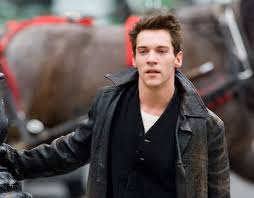
Jonathan Rhys Meyers (born 27 July 1977) is an Irish Golden Globe-winning actor. The very handsome Rhys Meyers has starred in television series including Gormenghast (2000) and in the CBS 4-hour mini-series Elvis (2005) as Elvis Presley alongside Rose McGowan as Ann-Margret. The latter earned him an Emmy nomination and a Golden Globe win. He is currently starring in the Showtime series The Tudors (2007) as young Henry VIII.
Among many movie credits Rhys Meyers starred in Woody Allen's brilliant film Match Point, for which he received a Chopard Trophy at the Cannes Film Festival.
On Sunday 18 November 2007 Rhys Meyers was arrested in Dublin Airport and charged with being drunk and in breach of the peace. He was later released on bail to appear at the Dublin District Court on 5 December 2007.[6] He was in Dublin to promote his new movie August Rush on the Irish television programme Tubridy Tonight.
Two days later, on November 20, the actor's mother, Geraldine Meyers-O'Keeffe, died after being admitted to the Mercy Hospital in Cork. She was 50 years old.[7]
Rhys Meyers also has experience as a singer, and sings several songs in this movie. Notes on Fairy tales:
Bruno Bettelheim, the author of the book The Uses of Enchantment, (which I read in a literature course in college) wrote: ".. if children are allowed to read and interpret these fairy tales in their own way, they will get a greater sense of meaning and purpose in their lives." Therefore I will refrain from suggesting what meaning this movie seeks to present.
A Russian scholar by the name of Vladimir Yakovlevich Propp (1895 — 1970) analyzed the basic plot components of Russian folk tales to identify their simplest irreducible narrative elements. These plot components that he identified turned out to cross over from just Russian folk/ faerie tales to folk/ Fairy tales in general.
The movie August Rush fits into his sequence easily:
After the initial situation is depicted, (In flashbacks, we see how Lyla Novacek (Waitress's Keri Russell), an acclaimed classical cellist, met and shared a romantic evening with Louis Connelly (The Tudors' Jonathan Rhys Meyers), a singer and guitarist with an Irish rock 'n' roll band.)
1. A member of a family leaves home & the hero is introduced - In this case Evan (Freddie Highmore) is orphaned.
2. An interdiction is addressed to the hero ('don't go there')-In this case Evan is told not believe that he will ever be reunited with his biological parents.
3. The interdiction is violated (villain enters the tale); -While taking the search for his parents on his own by running away from the orphanage Even meets Wizard (Robin Williams)), a Faginesque former musician who lives off the musical talents of his young, errant wards.
4. The villain makes an attempt at reconnaissance ( a preliminary survey to gain information)
5. The villain gains information about the victim-
6. The villain attempts to deceive the victim to take possession of victim or victim's belongings 7. Victim taken in by deception, unwittingly helping the enemy
8. a member of family lacks something or desires something
9. Misfortune or lack is made known 10. Seeker agrees to, or decides upon counter-action
11. Hero leaves home;
12. Hero is tested, interrogated, attacked etc, preparing the way for his/her receiving magical agent or helper (donor); 13. Hero reacts to actions of future donor
14. Hero acquires use of a magical agent
15. Hero is transferred, delivered or led to whereabouts of an object of the search;
16. Hero and villain join in direct combat; T
18. Villain is defeated (defeated in contest)-
19. Initial misfortune or lack is resolved (object of search distributed, spell broken, slain person revived, captive freed);
20. Hero returns; Evans
26. Task is resolved; Evans goal in writing his musical piece was so that many would hear it- and perhaps his real parents
27. Hero is recognized :Evan is recognized by his mother as he conducts.
28. False hero or villain is exposed; left alone the wizard play his music, but no one an hear him 29. Hero is given a new appearance (is made whole, handsome, new garments etc);
31. Hero ascends the throne (is rewarded)
What others are saying:
By Carina Chocano, Los Angeles Times Staff Writer
"August Rush" feels like the cinematic equivalent of being stuffed with fruitcake and doused with a gallon of egg nog, so if that's the sort of thing you go in for around the holidays . . . Freddie Highmore ("Finding Neverland") stars as a Dickensian orphan with an ear so prodigious that he can hear the music in everything. -----------------------------
August Rush is perfect for people who like good stories and music. I know I do and therefore am excited about this movie.
August Rush is about an orphaned boy that uses his musical talent as a clue to finding his birth parents. Dramas combined with adventure and fairy tale elements can never go wrong. I remember the last movie I saw in this similar genre is Big Fish, which is yet another reason to expect good things (but don't compare it with this one too much
Stephen King's The Mist (2007) Starring: Thomas Jane, Andre Braugher, Laurie Holden, Amin Joseph, Frances Sternhagen, Alexa Davalos, Sam Witwer, Jeff DeMunn, Brian Libby, Marcia Gay Harden, Toby Jones Director: Frank Darabont Rated: R for violence, terror and gore, and language U.S. Opening Date: 21 November 2007
There are no cheap thrills in the Mist that make you jump out of your seat . The Mist deals with serious issues like politics and religion and about how fear can cause people to believe anything.It's also a doomsday thriller. Unfortunately it is burdened by a dialogue-heavy pace; when something weird will happen several haracters will spend the next 10 minutes discussing the event. And much of the dialogue is campy and/or cheesy, or just plain stupid.
One of the first images you'll see in "The Mist" is a movie poster of John Carpenter's "The Thing." That 1982 classic which also tried to be intelligent while at the same time filled with a growing paranoia and a good amount of gore. The mist falls way short of that film.
And then the conclusion.... I will not give it away at all, but I'll comment on it in this articles conclusion.
Plot
The plot is rather simple. On the morning after a hurricane hits a a small East Coast town artist David Drayton (Thomas Jane) and his son (Nathan Gamble) decide to head into town to get some groceries and supplies to fix up their busted house.when everyday citizen Dan Miller(Jeffrey DeMunn) runs into the supermarket yelling, "There’s something in the mist!" A strange, all-encompassing gray mist proceeds to swoop in and cover the entire town, forcing David and many others to take shelter inside the supermarket Soon, giant eel-like tentacles slip under the loading-dock door and drag away Norm the bag boy, ( a good scene filled with interesting male competitiveness) unbelievably only Drayton and three others witness, and no one in the store hears. The witnesses have to convince the other shoppers of their peril. (It's also unrealistic that the Mist didn't attempt to come in when it had the chance.)
Grocery-shopping religious zealot Mrs. Carmody(Marcia Gay Harden) preaches to her fellow shoppers how the mist represents the time of judgment(not to mention how God’s will demands blood), as human casualties rise, supermarket civilians begin listening to Carmody’s preaching. Now, Drayton must decide which group rests as a bigger threat to his son: violent mist or religious fanatics.
So, there you have it: the set-up. an elaborate monster in the house type of film. "The Mist" raises the inevitable question of who the real monsters are. ACTORS
Thomas Jane plays the ever-resourceful David and is easy to root for, a hansom-wholesome man of action and a sensitive artist.
Marcia Gay Harden plays the religious extremist who whips up the crowd with her fire-and-brimstone denunciations and shrieks "Now do you believe?!" Is harder to root for or like or find very believable as a character. Not the actresses fault -rather the script.
The actor Toby Jones ( who played the lead character of Truman Capote in the movie Infamouse (2006) )plays the runtish but resourceful grocery checker very well.
Jeffrey DeMunn, is an actor who has been in all of Darabont's films plays a rational man, rationally. Nothing stand out in the role - his presence just adding that sense of continuity for film buffs and fans of Darabont.
About the director
Frank Darabont was born in a refugee camp in 1959 in Montbeliard, France, the son of Hungarian parents who had fled Budapest during the failed 1956 Hungarian revolution. Brought to America as an infant, he settled with his family in Los Angeles and attended Hollywood High School. His first job in movies was as a production assistant on the 1981 low-budget film, Hell Night (1981), starring Linda Blair.
In 1977 Steven King sold a 23-year-old Darabont the rights—for all of one dollar—to an old story, The Woman in the Room. The short film that followed was Darabont's ticket to Hollywood.
Darabont is one of only six filmmakers in history with the unique distinction of having his first two feature films receive nominations for the Best Picture Academy Award: 1994's The Shawshank Redemption (1994) (with a total of seven nominations) and 1999's The Green Mile (1999) (four nominations). Darabont himself collected Oscar nominations for Best Adapted Screenplay for each film (both based on works by Stephen King)
The Mist based on King's 27 years old novella, is the shortest recent movie Darabont has made, (and it's still too long).
Conclusion
The Mist" contains intense moments but it is slowed down too much by bad dialog.
And about the conclusion.... Darabont abruptly abandons Steven King's text in the movie's final minutes. I think Darabont should have kept the original ending, and instead taken the time to update the dialogue which comes almost verbatim from the 27 year old original text.
And though this has no bearing on the movie and is just a piece of trivia, the last word in King's story was "hope,".
After sharing my opinion with a fellow movie lover, she conveyed the following wisdom: If you didn't like The Life Aquatic with Steve Zissou (2004), The Royal Tenenbaums (2001)Rushmore (1998) then you won't like this film. it is all about appreciating the work of director Wes Anderson." The Darjeeling Limited 2007 Movie Review
My immediate after the movie review: Bad writing. Plot Boring. Mishaps that become 4. not so much predictable as unsurprising. Exceptional cast - Angela Houston the stand out performance. A lot of time building up characters that never brings any value to the whole. Exemplifies the stupid rich on a spiritual quest and mocks those who see themselves as spiritual & Indians in general. Movie is quite literally, about letting go of your baggage. Pretty good music at beginning and end. Quirky to the point of being funny at times but at other times the `love-me-I'm-so-quirkily-vulnerable' is unapealing. Could be considered a extra-dry exposition in humor.
Basic plot: Comedy about three brothers (Jason Schwartzman, Owen Wilson and Adrien Brody) who, to gain emotional healing and closure after the death of their dad, travel across India to find their mother who is living in a monastery. A few additional notes on this movie.
First I did not see the pre-movie. In Venice, the movie screened with a 13-minute short, "Hotel Chevalier," identified in the end credits as "Part 1 of 'The Darjeeling Limited.' " Completed in 2005, this short shows the character Jack (Jason Schwartzman) and his ex-girlfriend (Natalie Portman) iat a Parisian hotel.
Supposedly, the short provides a potent prologue that further serves to make Jack the most sympathetic of the brothers and adds resonance to visual motifs that recur in the feature. Per Anderson, "Hotel Chevalier" will not be shown in theaters, but rather on the Internet (Itunes), at festivals and on DVD. (I will watch the short and update this review after.)
2. I went back and watched this movie because of Owen Wilson's recent suicide attempt. I have enjoyed Wilson in movies, and it has been his lightheartedness that has been so appealing to me.
I wondered about the serious nature of this film (Boys who loose thier father, feel the need for a spiritual quest - seeking a mother who has run away to live in a remote monastery)- and the fact that Wislson's face is completely badaged.
If Wilson had died after this movie, perhaps more could be read into it. Wilson's characters injuries come from a motorcycle accident, that the script seems to allude to as a possible suicide.
Maybe when I was watching the film I was hoping to gleam some sort of clues to Wilson's sadness. The closest I got was the scene when Wilson removes his bandages, giving us a glimpse at the hidden injuries. In the next scene the bandages are back on. Message being - his injuries are covered by his outward persona.
3. Other critics have said tha this is a companion pice to the Tenenbaums which I have not seen in some time. Maybe having that movie fresh in ones mind would make the experience a little better.
"The Darjeeling Limited is a classic curry covered confection. It seems superficially sublime, only to underscore its surface with deep, philosophical power. It’s about never wanting to grow up, and discovering that responsibility ain’t so bad. It’s like listening to a beautiful song and then realizing the lyrics describe a particularly disturbing issue. Anderson may be continuously labeled as strange and unconventional, but there is something most critics can’t deny. He is a master of the medium he is so frequently called out over, and The Darjeeling Limited is both a wonderful rebuttal, and recognizable explanation, for such fractured feelings.
A telling quote from the Director Wes Anderson: I want to try not to repeat myself. But then I seem to do it continuously in my films. It's not something I make any effort to do. I just want to make films that are personal, but interesting to an audience. I feel I get criticized for style over substance, and for details that get in the way of the characters. But every decision I make is how to bring those characters forward.-Review by Pul Grant (follower of Basho) 12/2007






 ,
,